Our privacy promise
Your words
belong to you.
A microphone deserves a higher standard of trust than any other sensor. This page is MemoRing's promise to you — each line a design constraint we build against, not a marketing claim.
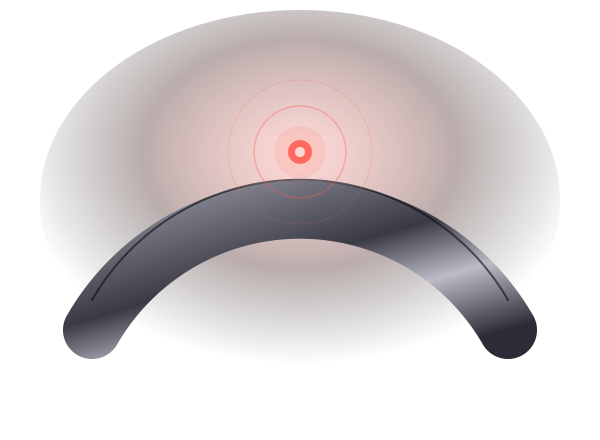
Designed to be seen
A recording light that never hides.
When MemoRing records, its light breathes in plain sight. It cannot be switched off, and no covert mode exists in the firmware. We made this a hard product rule, not a setting: MemoRing is a memory tool, never a surveillance device. Everyone in the room can see it working.
Four promises
1 · Your recordings are yours
Every recording and every transcript belongs to you. Delete anything, anytime — and deleted means gone, removed from your devices and our servers alike, not merely hidden from a list. Export everything whenever you want.
2 · Encrypted in transit and at rest
From ring to phone and phone to cloud, your audio travels encrypted — and it stays encrypted at rest. Without your authorization, no one can access your content.
3 · AI works only for you
AI touches your recordings for exactly one purpose: transcribing and organizing them for you. Without your explicit consent, your content is never used to train models, and it is never sold or handed to third parties.
4 · Recording you can see
The breathing light is always on while recording — non-disableable, with no hidden mode. Transparency runs both ways: we're transparent with your data, and the ring is transparent with the people around you.
Recording and the law: read this first
Consent rules for recording differ by country and region. Our advice is one simple principle: tell people, and ask first. It's the law in many places — and it's basic respect everywhere.
What should I know in the United States?
Rules vary by state. Some states allow one-party consent, while others — California among them — require consent from all parties to a conversation. For calls across state lines, following the stricter standard is the safer practice. Know your state's rules before you record.
What should I know in the European Union?
Recording conversations that involve other people may constitute processing of personal data under the GDPR. Purely personal use is often exempt, but in professional contexts, obtain consent first and check the rules of your member state.
What should I know in Japan?
Recording a conversation you take part in is generally not unlawful, but publishing a recording or passing it to third parties may infringe privacy and personality rights. In business settings, inform and obtain consent beforehand.
What should I know in mainland China?
When recording conversations that include others, inform them and obtain consent beforehand. Using recordings beyond the conversation itself — such as public distribution — may implicate privacy and personal-information rights under the Civil Code and the Personal Information Protection Law.
The information above is general guidance and does not constitute legal advice. Always follow the laws in force where you are; consult a qualified lawyer if in doubt. (Copy pending legal review.)
Be first to MemoRing
Pricing and launch details are coming soon. Leave your email and you'll hear it here first — waitlist members get priority access.
We'll only use your email for MemoRing updates. No spam, no sharing with third parties. Ever.